
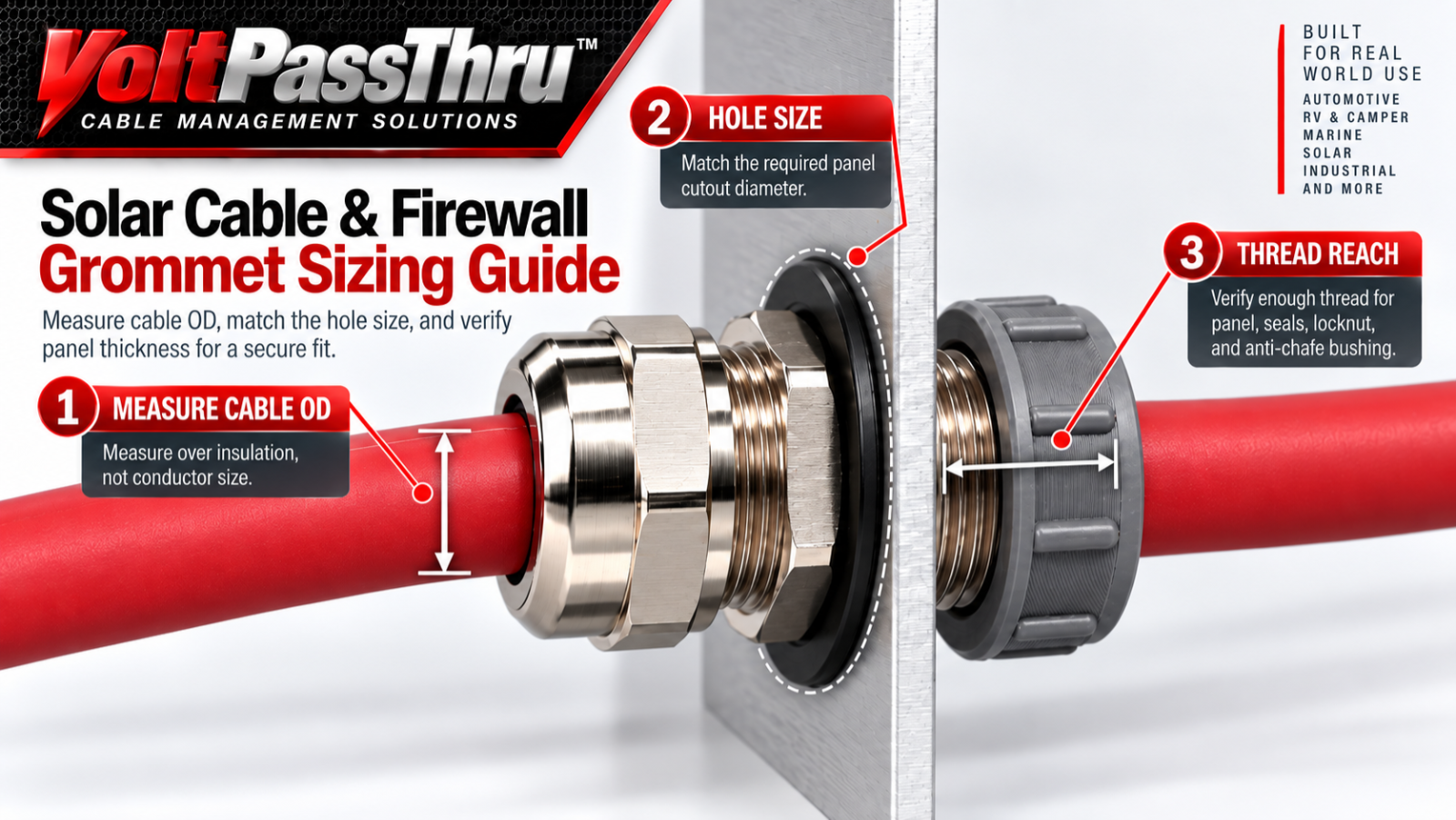
Help choose the correct VoltPassThru cable pass-through by matching the finished cable outside diameter, required mounting-hole size, and available thread reach. For solar, RV, battery-bank, and inverter wiring, actual cable O.D. is the primary sizing measurement because conductor gauge alone does not determine finished cable diameter.
↓ Metal Size Chart (3 – 18 mm)
↓ Nylon Size Chart (3 – 18 mm)
↓ Sizing FAQs
Sizing Guide Home →
Cable O.D. Range
Measure Finished Cable Diameter
Each gland features an adjustable compression seal with a verified minimum and maximum compatible cable diameter. For solar, RV, battery, and inverter wiring, measure the actual finished outside diameter of your cable (including jacket and insulation) with calipers before ordering. Conductor gauge (AWG) or cross-section (mm²) alone does not determine fit because dual-jacket PV wire and fine-strand battery cables vary widely in jacket wall thickness between manufacturers.
Mounting Hole Size
Required Panel Opening
This is the required panel, enclosure, bulkhead, floor, or wall opening for the selected gland. Dimensions are calibrated to allow the threaded barrel to pass through mounting surfaces without excess play, ensuring a secure, rattle-free mounting fit.
Usable Thread Reach
Available Thread Through Panel
This describes the available threaded barrel through the mounting panel. The locknut (~3/16″ / 5mm) and two external NBR panel sealing washers consume thread depth during assembly. Refer to the usable thread reach column to verify adequate grip through thick enclosure walls, sheet metal, camper partitions, and mounting plates.
Solar & RV Cable Pass-Through Size Chart – Metal
Constructed with a nickel-plated brass body, internal polyamide (PA) compression claw, internal NBR sealing components, and an extended threaded mounting barrel. Includes two external NBR panel sealing washers and a brass locknut for combiner boxes, camper bulkheads, and metal enclosure entries.
| 1 Cable O.D. Range | Model / SKU | 2 Mounting Hole Size | Thread Barrel Length | 3 Usable Thread Reach | Typical Installation Notes | Action |
|---|---|---|---|---|---|---|
| 10 – 18 mm (3/8″ – 11/16″) |
GLA30001-x1 | Confirm against hardware (unmeasured clearance) |
11/16″ (18mm) | Ensure full nut engagement (18mm barrel) |
Common applications may include heavy battery bank interconnects and main inverter DC feeder lines within the 10–18mm range. Confirm actual cable O.D. before selecting. | View 10–18 mm Metal |
| 6 – 12 mm (1/4″ – 1/2″) |
GLA30004-x1 | Confirm against hardware (unmeasured clearance) |
11/16″ (18mm) | Ensure full nut engagement (18mm barrel) |
Typical uses may include DC-to-DC charger lines, solar charge controller feeds, and medium battery runs within the verified 6–12mm O.D. range. | View 6–12 mm Metal |
| 5 – 10 mm (3/16″ – 3/8″) |
GLA30008-x1 | Confirm against hardware (unmeasured clearance) |
19/32″ (15mm) | Ensure full nut engagement (15mm barrel) |
Typical uses may include dual-conductor solar array feeds, branch circuit wiring, and exterior sensor lines within the verified 5–10mm O.D. range. | View 5–10 mm Metal |
| 3 – 6.5 mm (1/8″ – 1/4″) |
GLA30010-x1 | Confirm against hardware (unmeasured clearance) |
19/32″ (15mm) | Ensure full nut engagement (15mm barrel) |
Typical uses may include single-conductor PV strings, battery temperature monitor probes, and communication wiring within the verified 3–6.5mm O.D. range. | View 3–6.5 mm Metal |
Solar & RV Cable Pass-Through Size Chart – Nylon
Constructed from PA6 nylon featuring a divided internal clamping structure and EPDM internal sealing components. Non-conductive profile sized for camper van roof penetrations, battery partitions, and plastic junction boxes. Includes two external NBR panel sealing washers and a nylon locknut.
| 1 Cable O.D. Range | Model / SKU | 2 Mounting Hole Size | Thread Depth | 3 Usable Thread Reach | Typical Installation Notes | Action |
|---|---|---|---|---|---|---|
| 11.5 – 18 mm (7/16″ – 11/16″) |
GLA10001-x1 | Confirm against hardware (unmeasured clearance) |
9/16″ (14.5mm) | Ensure full nut engagement (14.5mm barrel) |
Common applications may include inverter DC feeds and battery storage entries through non-conductive fiberglass or composite partitions. Confirm actual cable O.D. | View 11.5–18 mm Nylon |
| 8 – 12 mm (5/16″ – 1/2″) |
GLA10004-x1 | Confirm against hardware (unmeasured clearance) |
19/32″ (15mm) | Ensure full nut engagement (15mm barrel) |
Typical uses may include solar charge controller feeds and DC-to-DC charger lines within the verified 8–12mm O.D. range. | View 8–12 mm Nylon |
| 5 – 10 mm (3/16″ – 3/8″) |
GLA10008-x1 | Confirm against hardware (unmeasured clearance) |
9/16″ (14.5mm) | Ensure full nut engagement (14.5mm barrel) |
Typical uses may include camper van roof penetrations, branch PV wiring, and auxiliary DC circuits within the 5–10mm range. | View 5–10 mm Nylon |
| 3 – 8 mm (1/8″ – 5/16″) |
GLA10010-x1 | Confirm against hardware (unmeasured clearance) |
9/16″ (14.5mm) | Ensure full nut engagement (14.5mm barrel) |
Typical uses may include PV string wiring, battery monitor shunt lines, and 12V LED lighting penetrations within the verified 3–8mm O.D. range. | View 3–8 mm Nylon |
How to Verify Fit for Solar, RV & Battery Cable
- Measure Finished Cable O.D.: Measure the completed cable jacket at several points using calipers, rotating 90 degrees to check for ovality. Do not pinch or compress the insulation.
- Match the O.D. Range: Choose only hardware whose verified clamping range includes your measured finished outside diameter. Never force oversized cable into a smaller gland.
- Verify Mounting Hole and Thread Reach: Before drilling, verify the required hole saw opening and confirm your enclosure or panel thickness falls within the usable thread reach.
- Check the Actual Installation: Confirm adequate rear clearance for the locknut and tightening tools, maintain safe cable bend radii, and keep clear of adjacent conductors and components.
Frequently Asked Sizing Questions
Start by measuring your cable’s actual finished outside diameter (O.D.) over the insulation jacket with calipers. Match that measurement to a pass-through whose verified Cable O.D. Range accommodates it, then confirm your panel mounting-hole size and usable thread reach. Conductor gauge or mm² alone is never sufficient for sizing.
No. Conductor ratings (like 10 AWG or 25 mm²) describe the cross-sectional area of the copper wire inside, not the exterior thickness of the insulation. PV solar wire, marine battery cable, and flexible welding cable vary widely in jacket wall thickness between manufacturers. Always measure finished O.D.
Use calipers to measure across the outer jacket without squeezing or compressing the insulation. Take two measurements 90 degrees apart to detect ovality, and use the larger reading to select your hardware range.
No. Finished outside diameter can vary between manufacturers and cable constructions even when the nominal conductor size is the same. Measure the actual finished cable jacket and compare it with the verified cable O.D. range before selecting a pass-through.
Mounting-hole size is model-specific. Once you select the correct Cable O.D. Range from our chart, use the exact mounting hole size listed (e.g. 1/2″ / 13mm for 3–6.5mm cable, 7/8″ / 21–23mm for 6–13mm cable, 1-1/8″ / 29mm for 12–18mm cable). Deburr the hole edges before inserting the gland to protect the sealing washers.
Selection depends on the actual finished cable outside diameter, required mounting-hole size, available thread reach, and the environmental or regulatory requirements of the specific installation. The same physical pass-through hardware may fit multiple applications when those requirements are satisfied.
Found Your Cable Size?
Choose the cable pass-through hardware that matches your measured cable outside diameter, required mounting-hole size, and available thread reach.
Not sure which size fits? Measure your cable’s finished outside diameter and contact us with the measurement.


