
Solar, battery, RV, and off-grid electrical systems often require cables to pass through enclosure walls, equipment partitions, and compartment panels. VoltPassThru cable glands provide threaded mechanical cable entry organized around actual cable outside diameter (O.D.), mounting-hole size, and usable thread reach. When correctly sized and installed, the compression system creates a dust-tight, air-tight, and weather-tight cable entry.
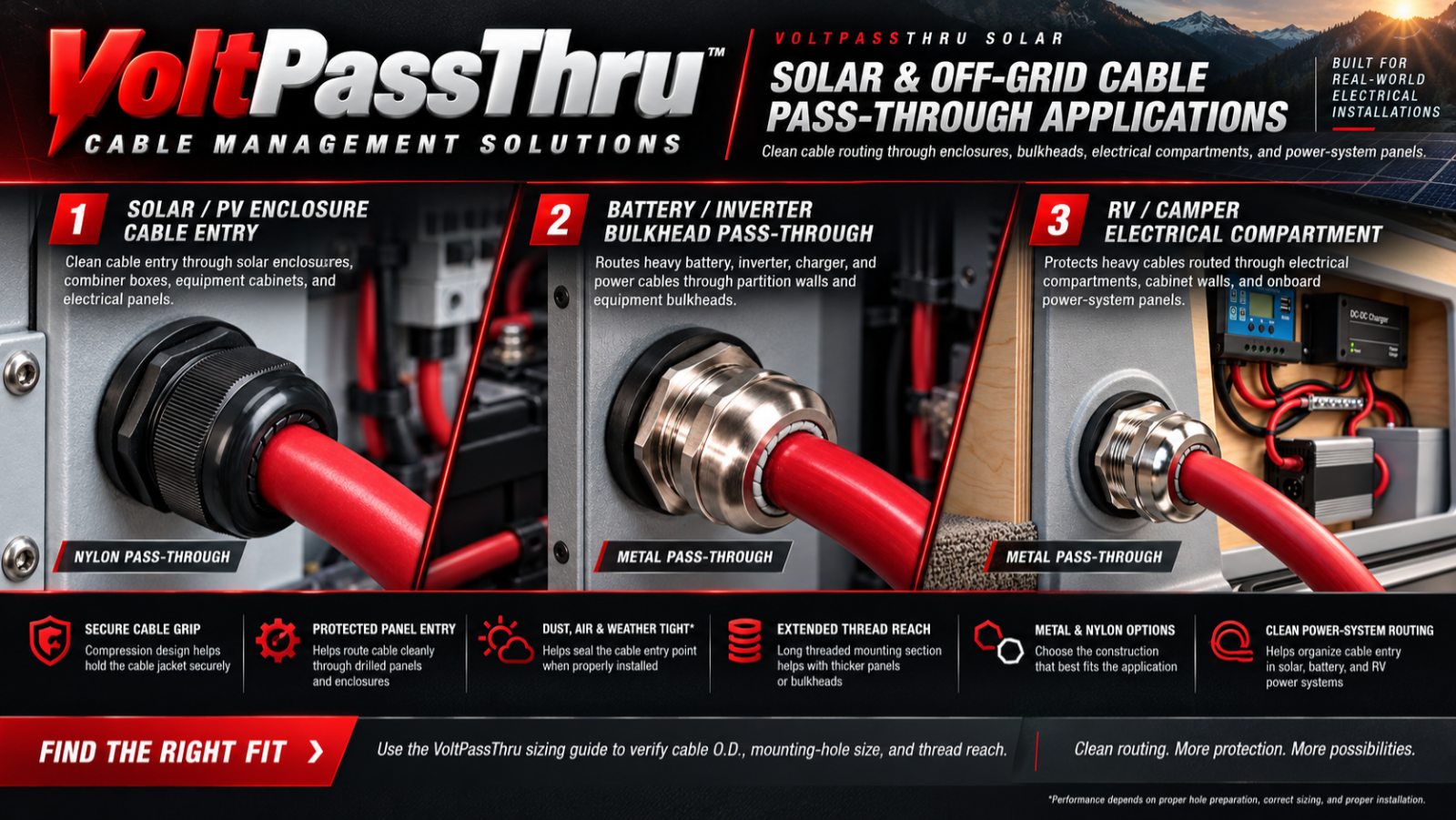
VoltPassThru Solar
Organized around measured cable outside diameter (O.D.) for solar enclosures, battery banks, inverter wiring, RV electrical systems, and off-grid power installations.
Common Solar & Off-Grid Cable Pass-Through Applications
Solar / PV Enclosure Cable Entry
Use cable glands where PV strings, charge controllers, sensor lines, or DC wiring cross electrical enclosure walls, combiner boxes, and equipment panels. The threaded fitting delivers mechanical cable grip, panel sealing, and strain relief organized by measured Cable O.D., with nylon and metal options to suit your enclosure requirements.
- Combiner box & outdoor junction-box cable entry
- Charge-controller & DC equipment enclosure feeds
- Monitoring, sensor & auxiliary wiring
Battery & Inverter Bulkhead Pass-Through
Heavy battery and inverter conductors require secure mechanical retention when crossing cabinet walls, battery-box partitions, and equipment bulkheads. Machined metal pass-throughs provide extended thread reach, generous rear clearance, and an anti-chafe exit bushing to protect heavy power cables against panel edges. Fit is determined by actual finished Cable O.D.
- Battery-to-inverter primary DC cable runs
- High-current battery feeds & DC-DC charger lines
- Cable routing between neighboring electrical compartments
RV & Camper Electrical Compartments
Route battery, inverter, solar, and auxiliary power wiring cleanly through compartment walls, cabinet partitions, and floor panels in RVs and camper conversions. Non-conductive nylon and heavy-duty metal options provide clean, protected entry points across living quarters and service bays. (For vehicle chassis or engine firewall routing, see our VoltPassThru Auto Series).
- House-battery and inverter compartment partitions
- Camper electrical service bays & utility cabinets
- Solar roof penetrations & auxiliary DC circuits
Why Use a Threaded Cable Gland for an Enclosure Entry?
A simple open hole or basic edge bushing protects the cable from direct contact with the panel edge, but it does not mechanically clamp or seal around the cable. A threaded compression gland combines panel mounting, cable grip, and cable sealing in one fitting. Correct Cable O.D., mounting-hole size, thread reach, and installation remain essential.
How to Choose the Correct Solar & Battery Size
Measure the completed cable jacket with calipers at several points. For Solar-series selection, finished outside diameter is the primary sizing measurement.
Choose only hardware whose verified compression range includes your measured finished Cable O.D.
Match the panel cutout to the selected pass-through model. Do not drill until the hardware size has been confirmed.
Confirm the threaded section provides sufficient usable reach for the enclosure wall, bulkhead, mounting plate, sealing components, and locknut.
Confirm there is adequate space behind the panel for the locknut, cable bend radius, anti-chafe component where applicable, and normal service access.
Recommended Hardware by Cable Outside Diameter
Heavy DC Feeder & Battery Cables
Common applications include heavy battery interconnects and main inverter DC feeder lines whose finished Cable O.D. falls within this verified range. Requires 1-1/8″ (29mm) mounting cutout.
Charge Controller & Mid-Sized Feeds
Typical uses include solar charge controller feeds, DC-to-DC charger lines, and mid-sized battery cables whose finished Cable O.D. falls within this range. Requires 7/8″ (21 – 23 mm) mounting cutout.
Solar Array & Branch Circuit Feeds
Typical uses include dual-conductor solar array home runs, branch circuits, and exterior sensor lines whose finished Cable O.D. falls within this range. Requires 3/4″ (19 – 20 mm) mounting cutout.
Single-Conductor PV & Sensor Leads
Typical uses include single-conductor PV strings, battery temperature probes, and auxiliary signal wiring whose finished Cable O.D. falls within this range. Requires 1/2″ (13mm) mounting cutout.
Polyamide Nylon Pass-Throughs
Lightweight polyamide (PA66) construction provides a non-conductive, corrosion-proof solution for electrical enclosure walls, combiner boxes, and camper cabinet partitions. Delivers reliable compression-based cable grip and strain relief.
Solar & Battery Installation Considerations
When correctly sized and properly installed, the compression gland creates a dust-tight, air-tight, and weather-tight cable entry around the cable jacket and mounting surface. Correct cable O.D., clean hole preparation, proper sealing-component placement, and secure tightening are important to the finished seal.
Measure Cable O.D. Before Drilling
Verify finished Cable O.D. with calipers before selecting hardware or cutting enclosure openings, as nominal conductor gauge does not determine jacket thickness.
Prepare a Clean Panel Opening
Cut and deburr the specified hole cleanly so sealing washers seat flat against a smooth enclosure or bulkhead surface.
Verify Enclosure Wall Thickness
Confirm the fitting provides sufficient usable thread reach for the panel wall, sealing washer, and rear locknut.
Maintain Cable Bend Radius
Provide adequate looping space inside combiner boxes and cabinets. Avoid forcing heavy battery or inverter cable into tight right-angle bends at the gland.
Support Heavy Cable Runs
Use external cable clamps or conduit supports along the cable run so the pass-through fitting is not required to carry the dead weight of unsupported spans.
Maintain Rear Service Clearance
Allow adequate interior room behind the panel for tightening the locknut, seating the anti-chafe bushing where applicable, and routine maintenance.
For physical mounting, washer orientation, and locknut tightening steps, see our VoltPassThru Installation Guide.
Frequently Asked Solar & Battery Sizing Questions
Ready to Find Your Size?
Measure your finished Cable O.D., then use the VoltPassThru Solar Sizing Guide to select the appropriate compression range, mounting-hole size, and thread reach.
Not sure which size fits? Measure your cable’s finished outside diameter and contact us with the measurement.
For trailer-mounted batteries, solar charging, or enclosed-trailer electrical systems, see our Trailer Wiring Applications guide.


