
Routing cable through a panel involves more than covering a sharp edge. A well-designed pass-through must secure the hardware to the mounting surface, grip the finished cable jacket, accommodate the panel thickness, and help seal the cable-entry interface.
VoltPassThru combines threaded panel retention, radial cable compression, extended mounting threads, sealing components, and metal or nylon construction for automotive, RV, solar, battery, and electrical installations.
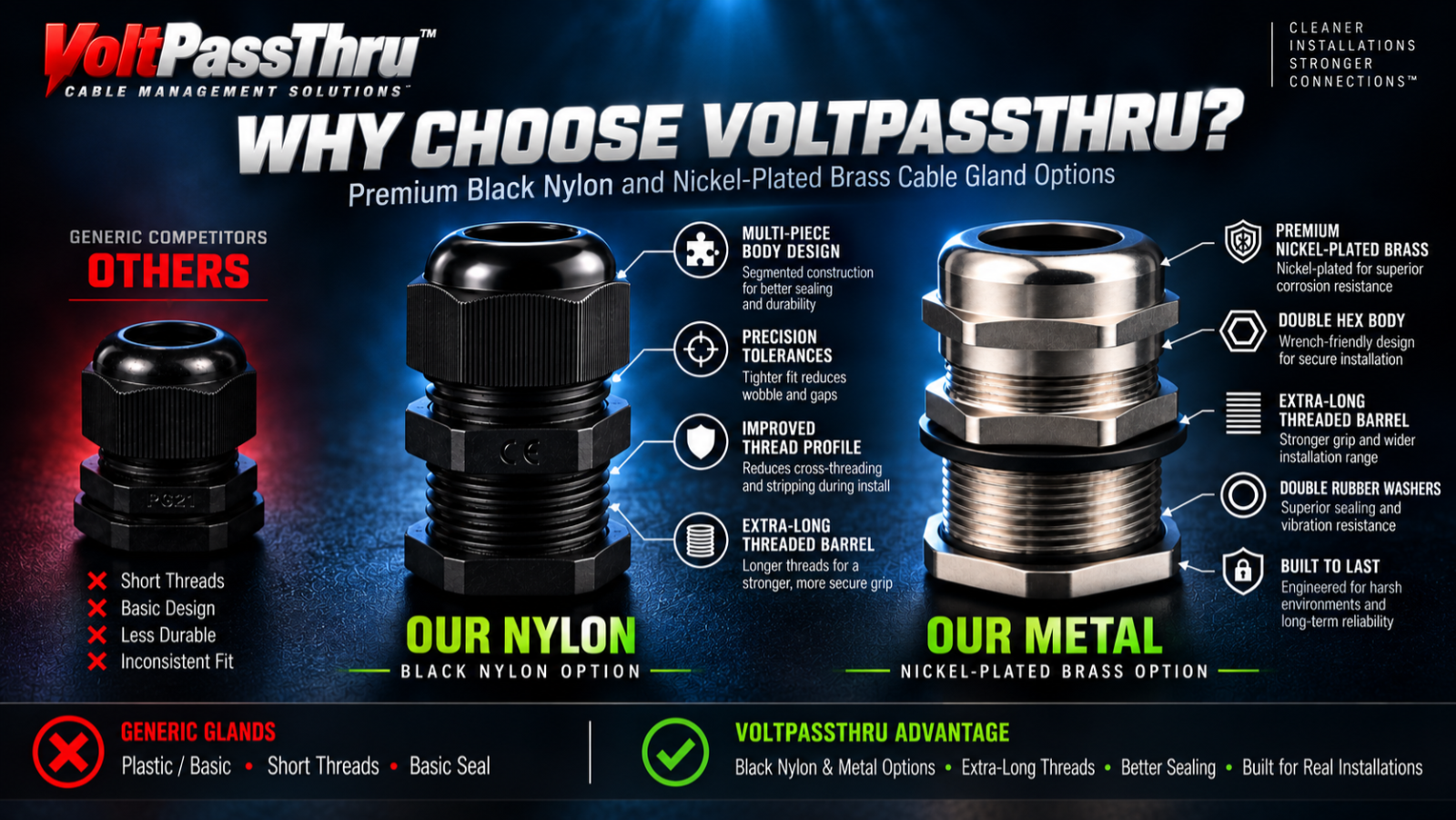
Built Around Real Cable-Routing Problems
Traditional pass-through methods like rubber push-in plugs or plastic snap bushings were created for light-duty, static installations. High-current power runs and demanding vehicle or exterior environments present real-world mechanical stresses that require a dedicated engineering approach:
Mechanical Panel Retention
Cable Jacket Protection
Cable Movement & Strain Relief
Cable Entry & Panel Sealing
A Complete Cable Pass-Through System
Rather than treating cable pass-through as a single piece of molded rubber or snap plastic, VoltPassThru integrates multiple mechanical components into a coordinated system:
Threaded Mechanical Panel Retention
The threaded body passes through the mounting surface and secures with a rear locknut, mechanically clamping the fitting to the panel rather than relying on friction.
Divided Compression Cable Grip
Internal segmented compression fingers tighten radially around the cable jacket as the cap is torqued, providing positive mechanical grip and strain relief.
Dual NBR Panel Seals
Metal kits include nitrile rubber sealing washers for both sides of the panel, cushioning the mounting surface and creating a dust-tight, air-tight, and weather-tight seal.
Extended Mounting Threads
Metal models feature extended threaded barrels designed for thicker mounting surfaces and multi-layer barriers where standard snap-in grommets cannot reach.
Wrench-Friendly Installation
Integrated hex surfaces on the body, compression cap, and mounting locknut provide positive wrench engagement for controlled, secure tightening.
Metal & Nylon Construction Options
Available in nickel-plated brass for high mechanical durability and polyamide nylon for lightweight, non-conductive electrical isolation.
Protection on Both Sides of the Panel
Protection Shouldn’t Stop at the Front of the Panel
Many cable-entry solutions focus only on the visible side of the panel. Applicable VoltPassThru metal kits add a threaded rear anti-chafe bushing, creating a rounded cable-exit surface on the back side of the installation as well.
Cable Compression & Grip
- Cable compression cap & hex tool flats
- Divided internal compression claw
- Nitrile rubber cable seal
- Radial cable jacket grip & strain relief
Mechanical Panel Clamping
- Extended threaded body
- Front NBR panel sealing washer
- Rear NBR panel sealing washer
- Heavy-duty threaded mounting locknut
Anti-Chafe Exit Protection
- Threaded rear anti-chafe bushing (on applicable current metal kits)
- Smooth, radiused cable exit
- Helps separate cable jacket from raw rear hole edge
Extended Thread Reach for Real Installation Surfaces
Usable thread reach determines whether the panel seals, mounting surface, locknut, and any applicable rear hardware can all be installed securely. For installations where conventional short-thread fittings do not provide enough mounting depth, VoltPassThru metal models provide a long-thread cable gland design intended for thicker panels and layered mounting surfaces.
Common Real-World Mounting Surfaces:
To check exact thread reach, hole saw sizing, and barrel lengths across each size, see the Auto Firewall Grommet Sizing Guide and the Solar & RV Cable Gland Sizing Guide.
Built Around the Finished Cable — Not Just the Gauge Label
Wire gauge describes the conductor. Finished Cable O.D. determines whether the complete cable jacket fits the pass-through’s compression range.
Insulation thickness, flexible silicone jackets, welding cable, PV insulation, wire loom, and sleeving can substantially alter finished diameter. Measure the finished cable before selecting hardware or drilling.
How Threaded Pass-Throughs Differ from Push-In Grommets
A factual comparison between conventional push-in rubber grommets, plastic snap-in bushings, and VoltPassThru threaded pass-through systems:
| Feature | Rubber Push-In Grommet | Plastic Snap-In Bushing | VoltPassThru Threaded Pass-Through |
|---|---|---|---|
| Panel Retention | Friction / groove retention | Snap-tab retention | ✓ Threaded body + locknut mechanical clamping |
| Cable Grip | Typically separate from panel retention | Typically fixed opening | ✓ Radial compression around compatible cable O.D. |
| Panel Sealing | Depends on grommet profile | Depends on product design | ✓ Dedicated sealing components on applicable models |
| Mounting Depth | Designed for compatible panel thickness | Designed for snap-panel thickness | ✓ Extended threaded mounting reach on applicable models |
| Tool Interface | Usually hand-installed | Usually hand/snap installed | ✓ Hex wrench flats + threaded locknut |
| Cable-O.D. Adjustability | Fixed opening/profile | Fixed opening | ✓ Compression range specific to each model |
| Rear Exit Protection | Depends on installation | Depends on product | ✓ Threaded anti-chafe bushing on applicable current metal kits |
Choose the Construction That Fits the Installation
Both material options utilize threaded mechanical retention and compression cable grip. Select the body material that aligns with your specific application, environmental exposure, and structural requirements:
Polyamide Nylon
- Lightweight construction resistant to corrosion and chemicals
- Non-conductive body provides electrical isolation
- Divided compression cable grip with integrated radial sealing claw
- Threaded panel retention with positive locking nut
- Useful for compatible electrical enclosures, cabinetry, composite panels, interior panels, and lighter-duty pass-through applications
One Pass-Through Platform. Multiple Applications.
The VoltPassThru platform provides dedicated solutions across diverse electrical industries. Explore detailed sizing and installation guides for your specific field:
VoltPassThru Auto
- Car audio amplifier power cable runs
- Engine bay firewall penetrations
- Battery relocation to trunk or cabin
- Floor pan and bulkhead cable routing
VoltPassThru Solar
- Solar array PV enclosure cable entries
- Battery storage bank & inverter wiring
- Electrical cabinets & junction boxes
- Off-grid renewable power systems
RV & Camper
- Rooftop & exterior solar cable entry
- Auxiliary house battery compartments
- Living area electrical distribution
- Chassis pass-through for DC-DC charging
60-Day Money-Back Guarantee
VoltPassThru purchases are backed by RockinPrices’ 60-day return guarantee. Contact RockinPrices for eligibility and complete terms.
Frequently Asked Questions
What makes a threaded cable pass-through different from a push-in firewall grommet?
Push-in grommets rely on friction or snap tabs that can loosen under vibration and cable movement, and they primarily isolate the cable from the hole edge. VoltPassThru uses a threaded body and locknut to mechanically clamp the fitting to the panel, combined with an internal radial compression claw that grips the cable jacket and seals the penetration.
Why does VoltPassThru use Cable O.D. instead of wire gauge alone?
American Wire Gauge (AWG) describes the conductor cross-section, not the outer diameter of the finished insulation. Differences in insulation type, flexible silicone jackets, battery cable stranding, wire loom, and sleeving significantly alter overall cable diameter. Sizing by verified Cable O.D. ensures the compression seal fits the actual cable.
When should I choose metal instead of nylon?
Choose nickel-plated brass for high mechanical strength, demanding automotive or exterior environments, thicker panels requiring extended thread reach, and installations benefiting from a rear anti-chafe bushing. Choose polyamide nylon when you need a lightweight, non-conductive solution for electrical enclosures, RV cabinetry, or interior partitions.
What does the threaded anti-chafe bushing do?
On applicable current metal kits, the rear anti-chafe bushing threads directly onto the back of the pass-through barrel behind the panel. It provides a smooth, rounded plastic exit surface that shields the cable jacket from sharp hole edges and prevents insulation wear on the interior or back side of the installation.
Find the Right VoltPassThru for Your Installation
Start with where the cable is going, then verify the finished Cable O.D., mounting-hole size, panel thickness, and usable thread reach.
Need step-by-step drilling and mounting instructions? Visit our Installation Guide.


